
-
Newsletter – Number 21-Blackwater Report
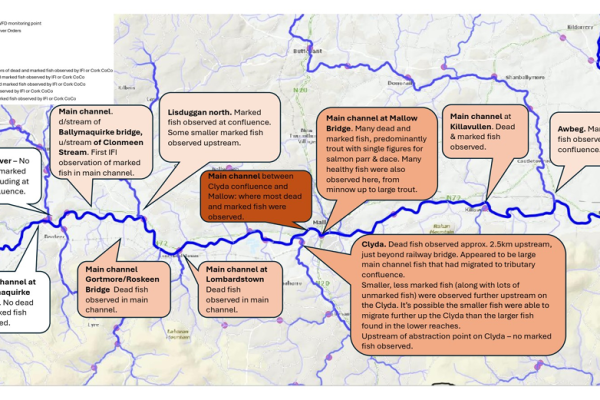
Today we’re sharing Salmon Watch Ireland’s Blackwater Report (Sept 2025). It summarises the Inter-Agency investigation into the August fish mortalities on the Munster Blackwater and sets out what must happen next. While we appreciate the efforts of all agencies and stakeholders it is none the less alarming that no definitive cause was identified. Whether this was the result of investigation taking too long to sample critical parameters or that event had occurred days before and had become non-detectable it should serve as a call to action by all to monitor and protect water quality. While we appreciate calls to actively restock these areas affected by the kill, we would suggest that natural recolonisation might be a better long term solution. What’s inside Up to 32,000 salmon and trout lost; oxygen levels normal; no single toxin identified. Macroinvertebrates rated Q4–Q5 (Good–High), pointing to a short-lived irritant — but on top of chronic nutrient enrichment. Strong enforcement measures urged, including indictment and licence suspension for persistent polluters, plus continuous monitoring of all discharges. Calls to reform the nitrates derogation, deploy real-time sensors, and build Irish lab capacity for pollutant & algal toxin testing.
Continue reading -
Salmon – Are Mackerel an Issue
The Expansion of Northeast Atlantic Mackerel and Its Potential Impacts on Atlantic Salmon Introduction Since the mid-2000s, Northeast Atlantic mackerel (Scomber scombrus) have undergone a major northward and westward expansion, with large feeding migrations into Faroese, Icelandic, and Greenlandic waters. This shift has reshaped fisheries and sparked disputes among coastal states, but it may also have important ecosystem consequences — particularly for Atlantic salmon (Salmo salar), whose marine survival has declined dramatically over a long time period but has reached new lows consistent with timing of these fisheries and change in ocean ecosytem. Mackerel catches by country ICES data show how mackerel catches shifted after 2005. Norway has long been the dominant harvester, but Iceland, the Faroe Islands, and later Greenland developed large fisheries once mackerel began occurring in their zones. Russia also maintains a sizeable fishery. Expansion into feeding areas The rise in catches by Iceland, Greenland, and the Faroes reflects the northward and westward shift of the stock’s summer feeding distribution. Once concentrated in the North Sea and Norwegian Sea, mackerel have become abundant as far west as East Greenland. However this trend appears to be reversing with a trend of distribution coming back towards more normal areas. Also stock size is declining with ICES choosing to recommend large reductions in quota. Ecological overlap with salmon Atlantic salmon smolts leaving rivers in Norway, UK, and Ireland migrate into the Norwegian Sea and areas adjacent to feed during their first summer at sea. This is the region where mackerel have expanded and increased in biomass in recent decades. Both salmon post-smolts (Directly and Indirectly) and mackerel, along with other pelagic species, depend on copepods especially cold-water copepods whose abundance has declined in much of the area due to ocean warming. This creates strong potential for food competition. An often-overlooked aspect is not only the biomass of zooplankton, but also their energy density (calorific content), which directly affects the availability of larval fish and indeed other species and underpins the structure of the entire ecosystem. The combination of record-high mackerel biomass since the mid-2000s and declining prey quality and quantity may help explain why salmon survival at sea has fallen to historic lows. Today’s post-smolt feeding grounds are markedly less productive compared with earlier periods, when zooplankton were more energy-rich and plentiful. On top of this, the growth of large industrial pelagic fleets likely adds further pressure — not only through occasional salmon bycatch, but also by significantly altering food-web dynamics in these critical feeding areas. Management implications Fisheries: Without an agreed TAC, coastal states’ unilateral quotas have pushed catches well above ICES advice, averaging ~40% higher since 2010. This is now subject of agreed quotas but is still too large and is probably not controlled properly in international waters. Ecosystem: Heavy exploitation of prey resources by abundant pelagic fish (mackerel, herring, blue whiting) could reduce salmon growth and survival, with consequences for both wild populations and fisheries. Climate change: Continued warming is expected to reduce richness of resources, intensifying the competition. This is probably the largest challenge. Salmon from Ireland may now have to migrate further to gain sufficiant feeding. Conclusion The northward and westward expansion of mackerel is not just a fisheries management challenge but an ecosystem concern. The overlap of mackerel with salmon feeding areas, combined with declining zooplankton, provides a plausible mechanism for the observed collapse in salmon marine survival. Addressing this requires: Stronger international quota agreements to keep mackerel harvests within ICES advice. This may reduce Bycatch. Reporting of salmon in bycatch has been agreed but information must be relevant not just that salmon were taken. Location, weight, size and condition of fish should be reported. Integrated ecosystem monitoring of zooplankton, pelagic fish, and salmon. Recognition that salmon declines cannot be solved by freshwater measures alone — the marine ecosystem is central. In conclusion it must be accepted that we must do all we can to revitalise freshwater systems but the substantial effect of climatic change on ocean productivity may be largely responsible for declines. Directly- Change to ecosystem productivity. Indirectly- Expansion of valuable stocks of pelagics may have increased bycatch of salmon.
Continue reading -
Fish Counter Report and Update Blackwater
This issue contains a brief outline of the fish counter report for 2024 issued by Inland Fisheries Ireland as well as an update on Blackwater fish kill. We have strongly suggested that certain issues come to the forefront in regard to WWTP and Industrial discharges in all catchments and that climate resilience should be built into any existing discharge licenses. We have also highlighted the astonishing number of cattle in County Cork, with a considerable portion in the Blackwater valley. All these factors must be addressed before the long term future of the Blackwater can be put on a sound footing.
Continue reading