
-
Salmon Tagging Regulations – Newsletter Number 25 – November 25-2025
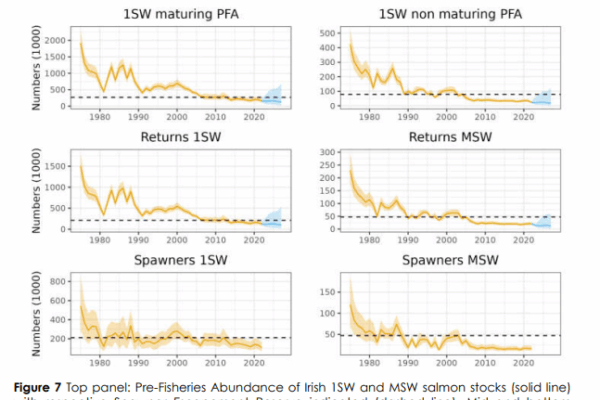
Across Ireland, Atlantic salmon stocks have reached alarmingly low levels, a situation clearly reflected in Inland Fisheries Ireland’s 2026 scientific assessments. Many rivers now fall below 65% of their Conservation Limit (CL) resulting in unprecedented numbers of rivers being designated Catch & Release only or fully closed under the 2026 Wild Salmon and Sea Trout Tagging Scheme Regulations. Our latest newsletter examines the legislation and calls for support.
Continue reading -
Newsletter Re: Exploitation – Number 24
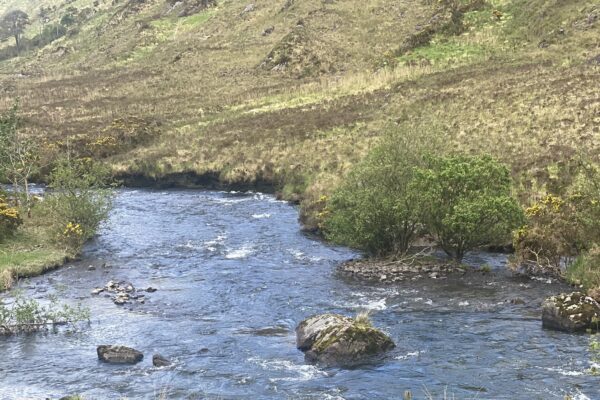
We are pleased to announce the release of our latest Wild Salmon Conservation Newsletter, which presents the initial key themes, priorities, and actions identified through public feedback on how best to manage exploitation and implement effective policies to increase wild smolt production and improve adult salmon returns. The newsletter highlights the issues that matter most to anglers, conservationists, and local communities—including enforcement, habitat restoration, marine survival challenges, aquaculture concerns, and the urgent need for coordinated action across agencies. Your input has been invaluable, and this summary reflects the collective voice of those committed to protecting Ireland’s wild salmon. We encourage you to read it, share it, and continue engaging as we move forward with stronger advocacy and evidence-based policy proposals. If you have any comments or wish to contribute further, we’d be delighted to hear from you. The survey is still live and you are welcome to contribute if you have not done so. Thank you for your continued support and dedication to safeguarding our wild salmon. Wild Salmon Conservation Newsletter Number 24
Continue reading -

Conference Proceedings – Salmon Watch Ireland, Athlone 11 October 2025
This special conference edition — “Protecting Wild Salmon: Science, Stewardship, and Accountability” — captures the key discussions and outcomes from our 2025 Athlone Conference. Inside you’ll find: Science and Survival: Dr. Elvira de Eyto on seven decades of data from Burrishoole, and Dr. Paddy Gargan confirming the clear link between sea lice and salmon mortality. Grassroots Action: Maura Brennan’s Nore Vision project showing the power of community-led stewardship. Policy and Law: Emma Armshaw (SWAN) on the incompatibility of open-net salmon farming with EU clean-water directives. A Call to Action: From pollution reporting to citizen science — discover how you can make a difference. Thank you for your continued support in protecting Ireland’s wild salmon. Newsletter Number 22 Final
Continue reading -

Deenish Island – ALAB Determination – Letter to Minister Heydon DAFM
Dear Minister Heyden, On behalf of Salmon Watch Ireland, I write to express our profound concern at the recent determination of the Aquaculture Licences Appeals Board (ALAB). The decision, in our considered view, undermines the protection of Ireland’s wild Atlantic salmon and sea trout and fails to uphold the standards required under Irish and European law. The determination highlights a deeply troubling reality: operators, despite having breached and continuing to breach the terms and conditions of their licences, appear able to operate without sanction. This sets a dangerous precedent, erodes public confidence in the regulatory process, and calls into question the integrity of environmental governance. We are further concerned that: The impacts on wild salmon and sea trout populations, particularly within the Waterville system and other iconic fisheries, were not adequately assessed. The implications for angling tourism — a vital contributor to rural economies — were ignored. Key inspections were delayed, raising doubts as to whether site-specific environmental risks were properly evaluated. The recent transfer of salmon other than smolts, currently under investigation by your Department, raises serious compliance and biosecurity issues that underscore the need for stricter enforcement. Minister, you will recall that in 2019 your Department issued an enforcement order in response to similar breaches, ensuring that aquaculture operators were held to account. The present circumstances demand no less. A comparable order is urgently required to prevent further non-compliance and ecological damage. We must highlight the continuing reliance on Section 19A(4) of the Fisheries (Amendment) Act 1997, which permits aquaculture operators to continue operating under their original licence terms and conditions while renewals have been lodged. In its Deenish determination (AP1/2019), ALAB accepted that condition 2(e) of the licence had been blatantly breached. Harvesting almost four times the legal limit is not a technicality; it is a wholesale disregard for the terms of the licence. Yet ALAB concluded that revoking the statutory entitlement would be “disproportionate.” MOWI has previously sought to amend the terms and conditions of its licence; however, this request was refused by the State. Notwithstanding this refusal, the company has continued to operate in breach of its extant licence and remains in contravention of the legally binding terms and conditions governing its operations. The consequences of this are grave. Section 19A(4) can now be interpreted as a shield that allows operators who are in breach of their licences to continue farming under the protection of the "law", even while those breaches remain unpunished. No fines, no suspensions, no meaningful sanction. The State’s hands are tied, not because it lacks evidence, but because the appeal process itself provides cover for non-compliance. This decision shatters the authority of the Minister and the Department to regulate aquaculture. It tells every operator that licence conditions are little more than suggestions, that breaches can be bargained away, and that even blatant non-compliance carries no real consequence. It empowers those already inclined to disregard the law, while leaving local communities and fragile marine environments unprotected and at risk. The integrity of Ireland’s regulatory regime depends on the principle that a licence is binding and enforceable. But Section 19A(4), as it currently stands, makes a mockery of that principle. Until this provision is repealed, aquaculture operators will continue to enjoy a legal loophole that lets them operate outside the law, immune from sanction, and secure in the knowledge that environmental safeguards can be breached without consequence. The Government has previously undertaken to delete Section 19A(4). That promise must now be honoured. Every day this provision remains in force, the credibility of aquaculture regulation is eroded, public trust is lost, and Ireland’s environmental protections are sacrificed to a system that rewards non-compliance. This undermines public confidence in the regulatory system and creates the perception that aquaculture operators can operate above the law. The provision fatally weakens environmental safeguards by allowing ongoing activity despite established breaches. You have previously undertaken to remove Section 19A(4). We therefore respectfully ask: when will this deletion be implemented? Until this section is repealed, the public will continue to perceive that aquaculture operators can breach conditions without consequence, and that the State’s regulatory regime tolerates non-compliance. The ALAB determination also exposes Ireland to potential breaches of binding European legislation, including: The Habitats Directive (92/43/EEC), requiring the strict protection of species and habitats of Community interest. The Water Framework Directive (2000/60/EC), obliging Member States to prevent deterioration of aquatic ecosystems. The Environmental Impact Assessment Directive (2011/92/EU as amended by 2014/52/EU), mandating rigorous assessment of projects likely to have significant environmental effects. The ALAB decision appears inconsistent with the precautionary principle and threatens both Ireland’s natural heritage and our compliance with EU law. Without corrective action, there is a real risk of irreparable ecological harm and legal exposure at European level. Minister, we therefore respectfully implore you to initiate a judicial review of this ALAB decision, to issue a new enforcement order as was done in 2019, and to honour your commitment to delete Section 19A(4) without delay. We would welcome the opportunity to meet with you at the earliest opportunity to present detailed evidence of our concerns and to work constructively towards stronger safeguards for Ireland’s wild salmonid populations. Thank you for your urgent attention to this matter.
Continue reading -
Newsletter – Number 21-Blackwater Report
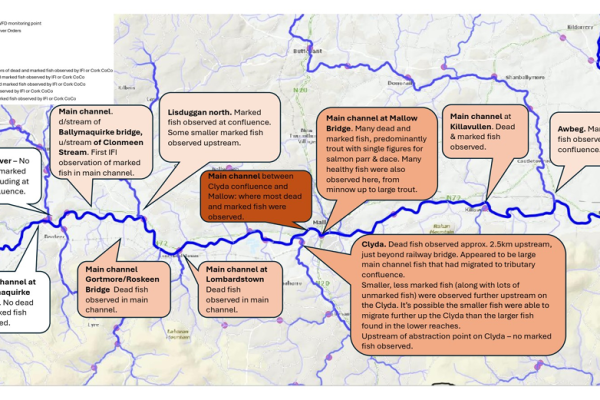
Today we’re sharing Salmon Watch Ireland’s Blackwater Report (Sept 2025). It summarises the Inter-Agency investigation into the August fish mortalities on the Munster Blackwater and sets out what must happen next. While we appreciate the efforts of all agencies and stakeholders it is none the less alarming that no definitive cause was identified. Whether this was the result of investigation taking too long to sample critical parameters or that event had occurred days before and had become non-detectable it should serve as a call to action by all to monitor and protect water quality. While we appreciate calls to actively restock these areas affected by the kill, we would suggest that natural recolonisation might be a better long term solution. What’s inside Up to 32,000 salmon and trout lost; oxygen levels normal; no single toxin identified. Macroinvertebrates rated Q4–Q5 (Good–High), pointing to a short-lived irritant — but on top of chronic nutrient enrichment. Strong enforcement measures urged, including indictment and licence suspension for persistent polluters, plus continuous monitoring of all discharges. Calls to reform the nitrates derogation, deploy real-time sensors, and build Irish lab capacity for pollutant & algal toxin testing.
Continue reading -
Salmon – Are Mackerel an Issue
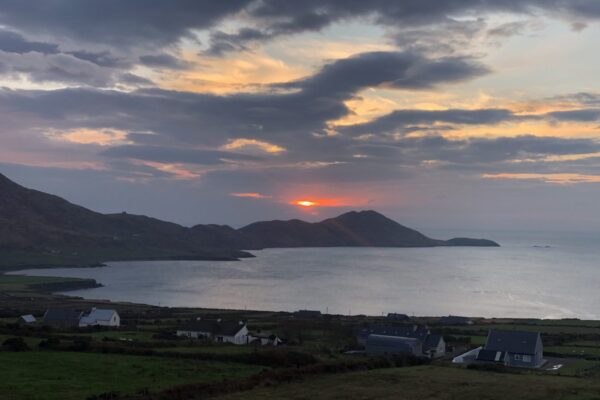
The Expansion of Northeast Atlantic Mackerel and Its Potential Impacts on Atlantic Salmon Introduction Since the mid-2000s, Northeast Atlantic mackerel (Scomber scombrus) have undergone a major northward and westward expansion, with large feeding migrations into Faroese, Icelandic, and Greenlandic waters. This shift has reshaped fisheries and sparked disputes among coastal states, but it may also have important ecosystem consequences — particularly for Atlantic salmon (Salmo salar), whose marine survival has declined dramatically over a long time period but has reached new lows consistent with timing of these fisheries and change in ocean ecosytem. Mackerel catches by country ICES data show how mackerel catches shifted after 2005. Norway has long been the dominant harvester, but Iceland, the Faroe Islands, and later Greenland developed large fisheries once mackerel began occurring in their zones. Russia also maintains a sizeable fishery. Expansion into feeding areas The rise in catches by Iceland, Greenland, and the Faroes reflects the northward and westward shift of the stock’s summer feeding distribution. Once concentrated in the North Sea and Norwegian Sea, mackerel have become abundant as far west as East Greenland. However this trend appears to be reversing with a trend of distribution coming back towards more normal areas. Also stock size is declining with ICES choosing to recommend large reductions in quota. Ecological overlap with salmon Atlantic salmon smolts leaving rivers in Norway, UK, and Ireland migrate into the Norwegian Sea and areas adjacent to feed during their first summer at sea. This is the region where mackerel have expanded and increased in biomass in recent decades. Both salmon post-smolts (Directly and Indirectly) and mackerel, along with other pelagic species, depend on copepods especially cold-water copepods whose abundance has declined in much of the area due to ocean warming. This creates strong potential for food competition. An often-overlooked aspect is not only the biomass of zooplankton, but also their energy density (calorific content), which directly affects the availability of larval fish and indeed other species and underpins the structure of the entire ecosystem. The combination of record-high mackerel biomass since the mid-2000s and declining prey quality and quantity may help explain why salmon survival at sea has fallen to historic lows. Today’s post-smolt feeding grounds are markedly less productive compared with earlier periods, when zooplankton were more energy-rich and plentiful. On top of this, the growth of large industrial pelagic fleets likely adds further pressure — not only through occasional salmon bycatch, but also by significantly altering food-web dynamics in these critical feeding areas. Management implications Fisheries: Without an agreed TAC, coastal states’ unilateral quotas have pushed catches well above ICES advice, averaging ~40% higher since 2010. This is now subject of agreed quotas but is still too large and is probably not controlled properly in international waters. Ecosystem: Heavy exploitation of prey resources by abundant pelagic fish (mackerel, herring, blue whiting) could reduce salmon growth and survival, with consequences for both wild populations and fisheries. Climate change: Continued warming is expected to reduce richness of resources, intensifying the competition. This is probably the largest challenge. Salmon from Ireland may now have to migrate further to gain sufficiant feeding. Conclusion The northward and westward expansion of mackerel is not just a fisheries management challenge but an ecosystem concern. The overlap of mackerel with salmon feeding areas, combined with declining zooplankton, provides a plausible mechanism for the observed collapse in salmon marine survival. Addressing this requires: Stronger international quota agreements to keep mackerel harvests within ICES advice. This may reduce Bycatch. Reporting of salmon in bycatch has been agreed but information must be relevant not just that salmon were taken. Location, weight, size and condition of fish should be reported. Integrated ecosystem monitoring of zooplankton, pelagic fish, and salmon. Recognition that salmon declines cannot be solved by freshwater measures alone — the marine ecosystem is central. In conclusion it must be accepted that we must do all we can to revitalise freshwater systems but the substantial effect of climatic change on ocean productivity may be largely responsible for declines. Directly- Change to ecosystem productivity. Indirectly- Expansion of valuable stocks of pelagics may have increased bycatch of salmon.
Continue reading -
Fish Counter Report and Update Blackwater
This issue contains a brief outline of the fish counter report for 2024 issued by Inland Fisheries Ireland as well as an update on Blackwater fish kill. We have strongly suggested that certain issues come to the forefront in regard to WWTP and Industrial discharges in all catchments and that climate resilience should be built into any existing discharge licenses. We have also highlighted the astonishing number of cattle in County Cork, with a considerable portion in the Blackwater valley. All these factors must be addressed before the long term future of the Blackwater can be put on a sound footing.
Continue reading -

Munster Blackwater – Fish Kill
Press Release Salmon Watch Ireland Expresses Deep Concern Over Major Fish Kill on the River Blackwater Salmon Watch Ireland is alarmed at the scale and extent of the recent fish kill on the River Blackwater. This tragic event highlights the ongoing pressures on the catchment, which continues to suffer from excessive nutrient inputs linked to agricultural intensification and inadequate wastewater treatment infrastructure. In addition, several licensed discharge points associated with dairy processing and other industries contribute further stress to the river system. While such licences may be deemed acceptable under normal conditions, the reality of increasingly frequent low rainfall and higher water temperatures significantly reduces the river’s capacity to assimilate these discharges. Current conditions have already resulted in extensive algal growth on the riverbed. The subsequent die-off of this algae can rapidly deplete dissolved oxygen, causing major mortality among fish and the invertebrate species that sustain the ecosystem. Elevated water temperatures compound this oxygen loss. Fish weakened under such stressful conditions are also far more vulnerable to secondary impacts such as fungal infections, further accelerating mortality and undermining the long-term resilience of populations. Salmon Watch Ireland believes this incident underscores the urgent need to address the Nitrates Derogation within the catchment and to review the licensing terms for discharges to surface waters. A comprehensive, catchment-wide remediation strategy is required, with full involvement of all stakeholders, if the ecological integrity of the Blackwater is to be restored. We await the outcome of tests being carried out by the relevant state agencies and call for full clarity on the causes of this ecological disaster.
Continue reading -

Launch of Salmon Watch Ireland’s 2025 Policy Statement – A Call to Protect Ireland’s Wild Atlantic Salmon
We are pleased to share with you Saving the Irish Salmon – Policy Statement 2025, Salmon Watch Ireland’s updated and comprehensive plan to safeguard one of our nation’s most iconic species. This revised policy builds on our original 2019 proposals and reflects the urgent challenges now facing wild Atlantic salmon. Numbers have fallen by approximately 90% since the 1970s, and without decisive action, salmon could become a rare sight in Irish rivers within our lifetime. The document outlines: The current crisis in salmon stocks, its causes, and the growing threats from climate change, habitat loss, pollution, overfishing, aquaculture impacts, by-catch and barriers to migration. A science-based framework for reversing the decline, focusing on habitat restoration, barrier removal, predator management, and stricter regulation of exploitation and aquaculture. Policy recommendations for government, agencies, communities, and international partners, including reforms to the Salmon Conservation Fund and the creation of an independent Aquaculture Authority. This is not just a policy document – it is a call to action. Protecting salmon will require leadership, cross-sector collaboration, and strong public support. We invite you to read the full statement, join the conversation, and help us in building the momentum for change. You can access the full policy document in the attached. While the policy document is comprehensive, we anticipate that the detailed management of Ireland’s salmon resource will need to evolve in response to emerging challenges, ensuring the strategy remains effective and delivers lasting results. Thank you for your continued commitment to Ireland’s environment and biodiversity. Together, we can ensure that future generations inherit healthy rivers and thriving salmon runs
Continue reading