
-
Newsletter Number 41 – 26 June 2026
Welcome to Newsletter No. 41 from Salmon Watch Ireland. As we move into the height of summer, our wild salmon and sea trout face increasing challenges from warming rivers, declining marine survival and ongoing human pressures. This edition examines the latest scientific evidence, including the newly published Norwegian Scientific Advisory Committee report, which concludes that salmon farming and climate change remain the two greatest human-induced threats to wild Atlantic salmon. We also report on the recent Joint Oireachtas hearings on aquaculture, where contrasting views were presented on the impacts of open-net salmon farming, and outline our recent submissions on proposed salmon farm developments and Ireland's Draft National Restoration Plan. In addition, we highlight a new national protocol for investigating fish kills and discuss why protecting salmon during periods of high water temperature is becoming increasingly important for both juvenile and adult fish. As always, we thank our supporters for their continued encouragement. Your support enables us to advocate for stronger protection of Ireland's rivers and to ensure that decisions affecting wild salmon are informed by the best available science. We hope you enjoy this edition and, as always, welcome your comments and feedback. Newsletter Number 41 26 June 2026
Continue reading -
Newsletter Number 38 – Blackwater Genetic Study
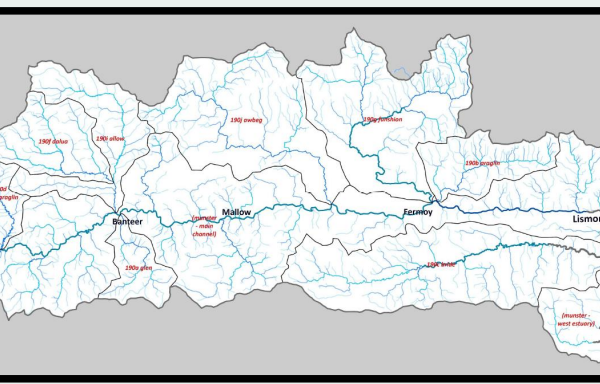
Salmon Watch fully supports and endorses this important project. The information gathered through the collection and analysis of salmon, sea trout and brown trout scale samples will greatly enhance our collective understanding of the Blackwater catchment, its individual tributary systems and the contribution each makes to the overall fishery. Importantly, this work may help identify key production units within the catchment, highlight areas which may not currently be achieving their natural potential and guide future investigative, conservation and habitat improvement work. The success of the programme will depend heavily on support and participation from the angling community. We would therefore strongly encourage all anglers, clubs and fisheries interests to participate fully during the season by submitting scale samples wherever possible and promoting the project locally. Every sample collected contributes valuable scientific information and will help build a clearer picture of the future management and protection needs of the Blackwater system. Your support and cooperation are greatly appreciated. Blackwater Genetic Study - Newsletter Number 38
Continue reading -
Salmon Watch Ireland Newsletter Number 33- 27 February 2026 Freshwater Survival Newsletter
This edition focuses on one of the most important, and often underestimated, stages in the salmon life cycle — freshwater survival before ocean entry. Drawing on long-term Irish research from systems such as the River Bush, Burrishoole, River Erriff, and southern rivers, the newsletter outlines: Evidence that significant mortality occurs during downstream migration The impact of low-flow, warm spring conditions on smolt survival The importance of discharge timing and spring freshets Increased risks associated with long estuaries How freshwater stress can compound with marine parasite pressures The critical role of genetic integrity and environmental stability The consistent message from Irish datasets is clear: freshwater conditions are not neutral — they strongly shape marine survival outcomes. We also introduce Hydronet, a comprehensive river data resource covering water height and temperature, which may be of interest to anyone examining historical or current river conditions. Freshwater survival is one of the most manageable stages in the salmon lifecycle, and protecting natural flow regimes, limiting abstraction during migration, maintaining connectivity, and reducing thermal stress can all make a measurable difference. I hope you find this edition informative and useful. As always, we welcome feedback and discussion Newsletter Number 33 - Freshwater Migration
Continue reading -
Newsletter Number 29 – 30 January 2025
The newsletter opens with an overview of a recent Canadian federal court ruling on salmon aquaculture, which confirmed the right of governments to act decisively and precautionarily in defence of wild salmon, even where such decisions carry significant economic consequences. This case provides a timely and relevant international context for policy and regulatory decisions now facing Ireland. The article then turns to domestic matters, including the proposed Wild Salmon and Sea Trout Tagging and Conservation Regulations, the scientific rationale for strengthened probability thresholds at Conservation Limit, the treatment of rivers assessed as having no exploitable surplus, and the implications of departing from established scientific and management advice. It also addresses the management of recreational exploitation, the protection of early-running fish, and Ireland’s obligations under EU conservation and Nature Restoration law. The intention of the newsletter is to contribute constructively to ongoing discussion by setting out the conservation, governance, and legal context in a clear and accessible way, while emphasising the need for evidence-led, precautionary decision-making in the face of continued stock decline. I hope you find it useful and informative, and I look forward to further engagement on these issues.
Continue reading -
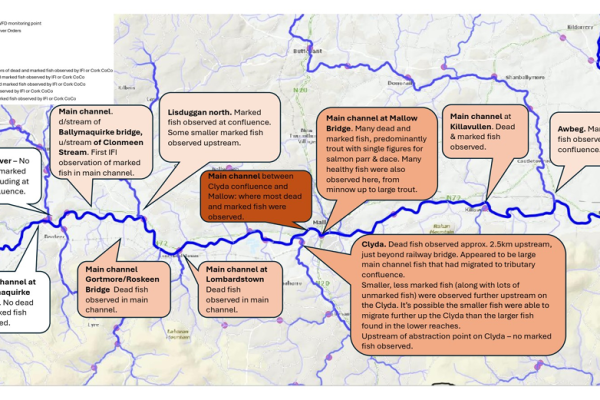
Newsletter – Number 21-Blackwater Report
Today we’re sharing Salmon Watch Ireland’s Blackwater Report (Sept 2025). It summarises the Inter-Agency investigation into the August fish mortalities on the Munster Blackwater and sets out what must happen next. While we appreciate the efforts of all agencies and stakeholders it is none the less alarming that no definitive cause was identified. Whether this was the result of investigation taking too long to sample critical parameters or that event had occurred days before and had become non-detectable it should serve as a call to action by all to monitor and protect water quality. While we appreciate calls to actively restock these areas affected by the kill, we would suggest that natural recolonisation might be a better long term solution. What’s inside Up to 32,000 salmon and trout lost; oxygen levels normal; no single toxin identified. Macroinvertebrates rated Q4–Q5 (Good–High), pointing to a short-lived irritant — but on top of chronic nutrient enrichment. Strong enforcement measures urged, including indictment and licence suspension for persistent polluters, plus continuous monitoring of all discharges. Calls to reform the nitrates derogation, deploy real-time sensors, and build Irish lab capacity for pollutant & algal toxin testing.
Continue reading -
Salmon – Are Mackerel an Issue
The Expansion of Northeast Atlantic Mackerel and Its Potential Impacts on Atlantic Salmon Introduction Since the mid-2000s, Northeast Atlantic mackerel (Scomber scombrus) have undergone a major northward and westward expansion, with large feeding migrations into Faroese, Icelandic, and Greenlandic waters. This shift has reshaped fisheries and sparked disputes among coastal states, but it may also have important ecosystem consequences — particularly for Atlantic salmon (Salmo salar), whose marine survival has declined dramatically over a long time period but has reached new lows consistent with timing of these fisheries and change in ocean ecosytem. Mackerel catches by country ICES data show how mackerel catches shifted after 2005. Norway has long been the dominant harvester, but Iceland, the Faroe Islands, and later Greenland developed large fisheries once mackerel began occurring in their zones. Russia also maintains a sizeable fishery. Expansion into feeding areas The rise in catches by Iceland, Greenland, and the Faroes reflects the northward and westward shift of the stock’s summer feeding distribution. Once concentrated in the North Sea and Norwegian Sea, mackerel have become abundant as far west as East Greenland. However this trend appears to be reversing with a trend of distribution coming back towards more normal areas. Also stock size is declining with ICES choosing to recommend large reductions in quota. Ecological overlap with salmon Atlantic salmon smolts leaving rivers in Norway, UK, and Ireland migrate into the Norwegian Sea and areas adjacent to feed during their first summer at sea. This is the region where mackerel have expanded and increased in biomass in recent decades. Both salmon post-smolts (Directly and Indirectly) and mackerel, along with other pelagic species, depend on copepods especially cold-water copepods whose abundance has declined in much of the area due to ocean warming. This creates strong potential for food competition. An often-overlooked aspect is not only the biomass of zooplankton, but also their energy density (calorific content), which directly affects the availability of larval fish and indeed other species and underpins the structure of the entire ecosystem. The combination of record-high mackerel biomass since the mid-2000s and declining prey quality and quantity may help explain why salmon survival at sea has fallen to historic lows. Today’s post-smolt feeding grounds are markedly less productive compared with earlier periods, when zooplankton were more energy-rich and plentiful. On top of this, the growth of large industrial pelagic fleets likely adds further pressure — not only through occasional salmon bycatch, but also by significantly altering food-web dynamics in these critical feeding areas. Management implications Fisheries: Without an agreed TAC, coastal states’ unilateral quotas have pushed catches well above ICES advice, averaging ~40% higher since 2010. This is now subject of agreed quotas but is still too large and is probably not controlled properly in international waters. Ecosystem: Heavy exploitation of prey resources by abundant pelagic fish (mackerel, herring, blue whiting) could reduce salmon growth and survival, with consequences for both wild populations and fisheries. Climate change: Continued warming is expected to reduce richness of resources, intensifying the competition. This is probably the largest challenge. Salmon from Ireland may now have to migrate further to gain sufficiant feeding. Conclusion The northward and westward expansion of mackerel is not just a fisheries management challenge but an ecosystem concern. The overlap of mackerel with salmon feeding areas, combined with declining zooplankton, provides a plausible mechanism for the observed collapse in salmon marine survival. Addressing this requires: Stronger international quota agreements to keep mackerel harvests within ICES advice. This may reduce Bycatch. Reporting of salmon in bycatch has been agreed but information must be relevant not just that salmon were taken. Location, weight, size and condition of fish should be reported. Integrated ecosystem monitoring of zooplankton, pelagic fish, and salmon. Recognition that salmon declines cannot be solved by freshwater measures alone — the marine ecosystem is central. In conclusion it must be accepted that we must do all we can to revitalise freshwater systems but the substantial effect of climatic change on ocean productivity may be largely responsible for declines. Directly- Change to ecosystem productivity. Indirectly- Expansion of valuable stocks of pelagics may have increased bycatch of salmon.
Continue reading -
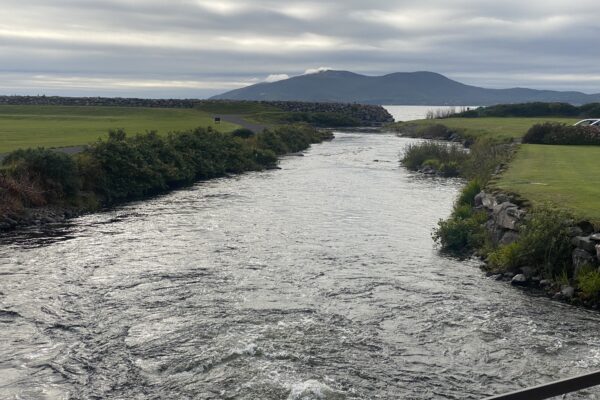
Kilkieran Bay Submission – Newsletter
Salmon Watch Ireland Submission – Kilkieran Bay Aquaculture Licence Review (July 2025) This submission from Salmon Watch Ireland strongly opposes the renewal and review of aquaculture licenses for salmon farming in Kilkieran Bay, County Galway, by Bradan Beo Teoranta (BBT). It argues that the application and its supporting environmental documentation fail to meet the legal and scientific standards required under Article 6(3) and 6(4) of the EU Habitats Directive, the EIA Directive, and recent relevant High Court judgments.
Continue reading -
Salmon Watch Ireland notes the recent online discussions regarding the by catch of salmon by industrial scale pelagic fisheries. We certainly agree that these pelagic fisheries are not being fished in a sustainable manner and the prospect of significant bycatch is certainly cause for concern.
Continue reading -

Newsletter Number 16 – 02 July 2025
Latest News on two submissions from Salmon Watch Ireland - Farms in Bantry Bay and Mulroy Bay. Appeal to Inland Fisheries Ireland to engage in real time management of salmon stocks this year due to serious decline across country.
Continue reading -

Newsletter Number 15 – 12 June 2025
NASCO – SALMON AT CRISIS LEVEL SALMON SURVIVAL STRESSOR ANALYSIS - IRELAND APPEAL FOR VOLUNTARY MEASURES CONSERVATION OF SALMON
Continue reading